Xiaomi Mijia M365 Scooter: Reviews, Specs, and Accessories
 PopScooter Team
February 8, 2026 9:24 am
.
17 min read
PopScooter Team
February 8, 2026 9:24 am
.
17 min read
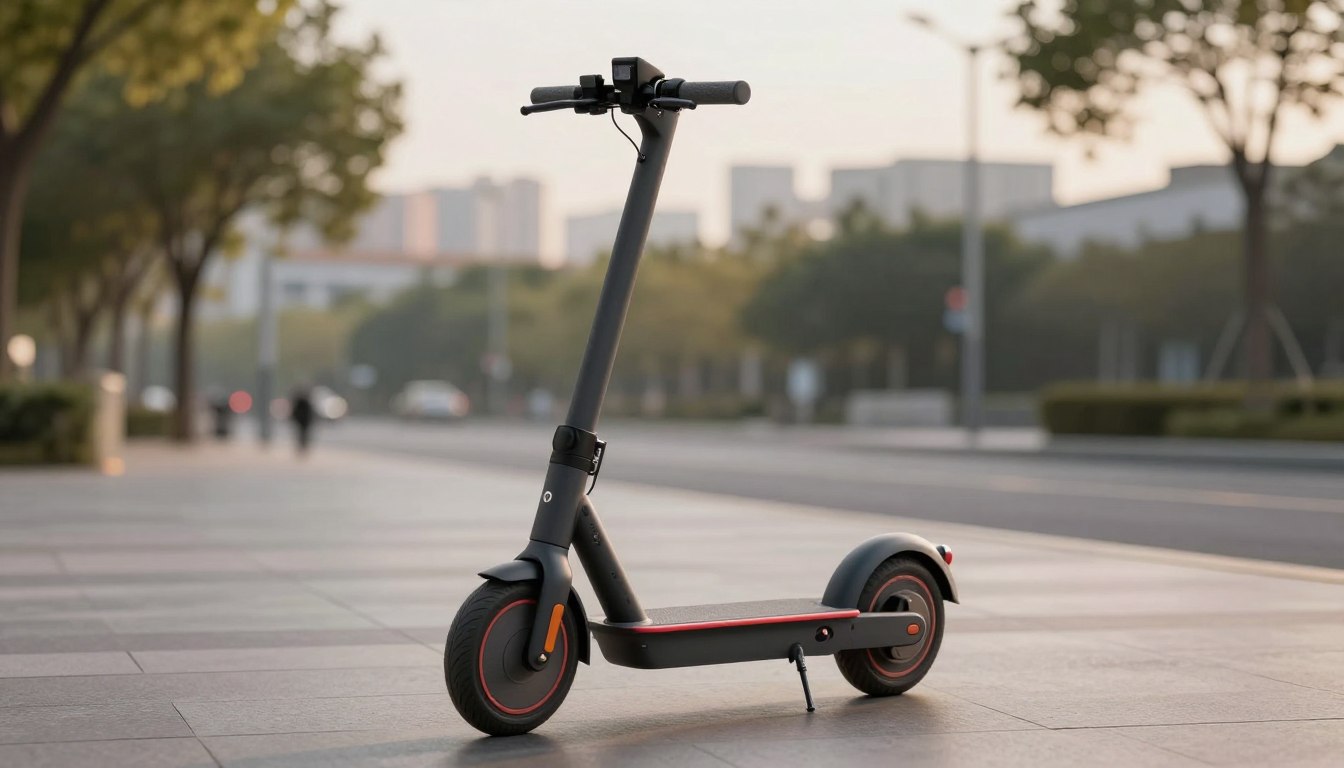
Can one simple commuter scooter still beat newer models for city rides? Many riders ask this as fleets from Bird and Lime made the model a familiar sight in U.S. streets.
The scooter earned its reputation for a compact fold, about a 16 mph top speed, and a claimed ~18-mile range. It was designed by Xiaomi and made by Ninebot, and it helped make scooters mainstream in many cities.
This introduction frames a practical review focused on real commuting needs: how it feels on typical roads, braking performance, realistic range, and which accessories truly help daily riders. It also explains naming confusion so shoppers know the model family.
Buyers should note that a large accessories ecosystem keeps the model useful, but fake units do appear on marketplaces when prices look too low.
Key Takeaways
- The M365 became mainstream after Bird and Lime deployments.
- Expect roughly 16 mph top speed and about 18 miles claimed range.
- This review focuses on commuter practicality: ride, brakes, and carry.
- A big accessories market can extend the scooter’s usefulness.
- Watch for counterfeit units when prices seem unusually low.
- The article will cover specs, ride, battery, accessories, comparisons, and a verdict.
Quick Take on the Xiaomi M365 for U.S. Commuters
The M365 is a solid mid-range option for everyday urban trips. It suits short-to-medium commutes where portability and easy controls matter more than top-end speed.
Who it fits best
Ideal riders include last-mile commuters, students on campus, and anyone doing mainly paved neighborhood routes up to about 15 miles per day.
With a roughly 16 mph top speed and an ~18-mile claimed range, it handles typical city chores without fuss.
Who should skip it
Pass if a rider needs higher speed, faster acceleration, or a dependable 20–40 mile real-world range.
Heavier riders and those facing frequent hills will notice reduced range and weaker hill performance. For range-focused buyers, consider other options among the best electric scooters available today.
- Buy if portability, simple controls, and light urban use are priorities.
- Skip if you require long range, high speed, or strong hill power.
- Accessories matter: brighter lights, flat prevention, and locks improve commuter reliability.
For a quick shopping check, compare this model to other top picks for range and speed before deciding. Or see a detailed retailer page for specs and availability at this listing.
xiaomi mijia m365 Specs at a Glance
Before comparing models, glance at the core numbers that shape ride performance and portability.
Top speed, motor power, and hill expectations
Top speed is about 16 mph on flat pavement. The rated motor is 250W with bursts up to 500W, so short hills are manageable.
Heavier riders and steep grades reduce acceleration and performance. Expect slower climbs and reduced top speed on long inclines.
Range and what affects real-world distance
The claimed range is ~18 miles, though many riders see ~15 miles under aggressive riding. Wind, frequent stops, cold, and rider weight all cut into the figure.
Real-world range varies — use conservative estimates for daily planning.
Battery, charge time, weight, and dimensions
The battery is roughly 280 Wh with a 42V 1.7A charger and a typical charge time near 5 hours.
The scooter weighs about 27.5 lb and supports around 220 lb. Unfolded it measures ~108 x 43 x 114 cm; folded it drops to ~108 x 43 x 49 cm.
- Tires: 8.5-inch pneumatic for better road feel but a flat risk.
- Water: IPX4 splash resistant — avoid heavy rain and deep puddles.
- Deck height: Low clearance can scrape on steep curbs.
Design, Build Quality, and Folding Portability
Design choices show quickly in daily use: how a scooter folds, feels, and moves matters most.
Frame, stem, and durability notes
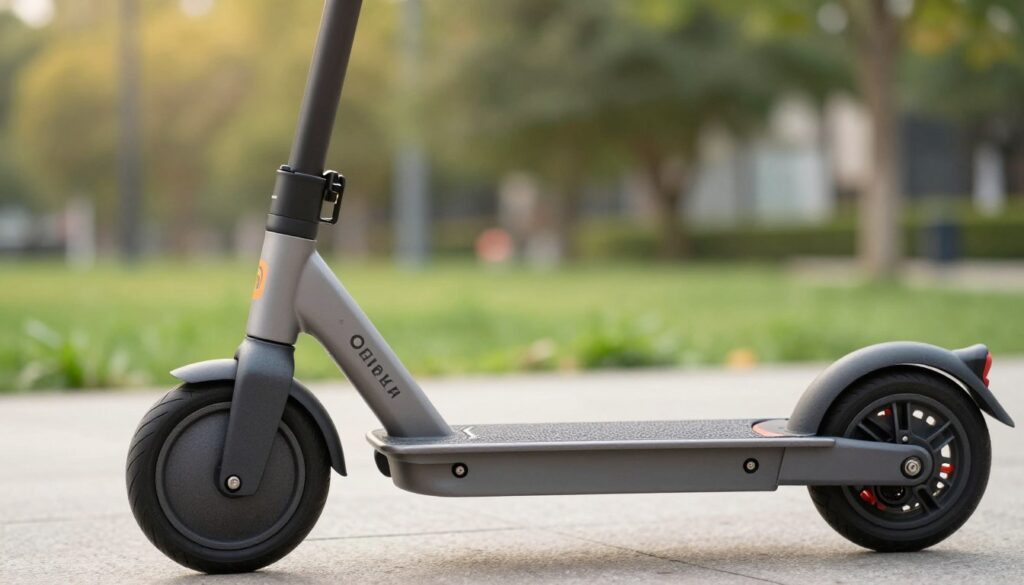
The aluminum frame gives a minimalist look and solid feel for the price. Riders notice less flex than cheap rivals, and the stem shows reasonable strength under normal commuting loads.
Over time, owners check the stem bolts and headset for any play. Regular fasteners checks keep wobble low and extend long-term durability.
Folding, carry, and rolling behavior
The folding latch is simple and can work in a few seconds—many users call it a three-second fold when smooth. That quick action makes door-to-desk transitions easy.
At ~27–28 lb some riders carry it short stairs, but most prefer to roll it where possible. The folded bell hook locks the deck to the rear mudguard and helps keep the package compact.
Handlebars, controls, and cockpit layout
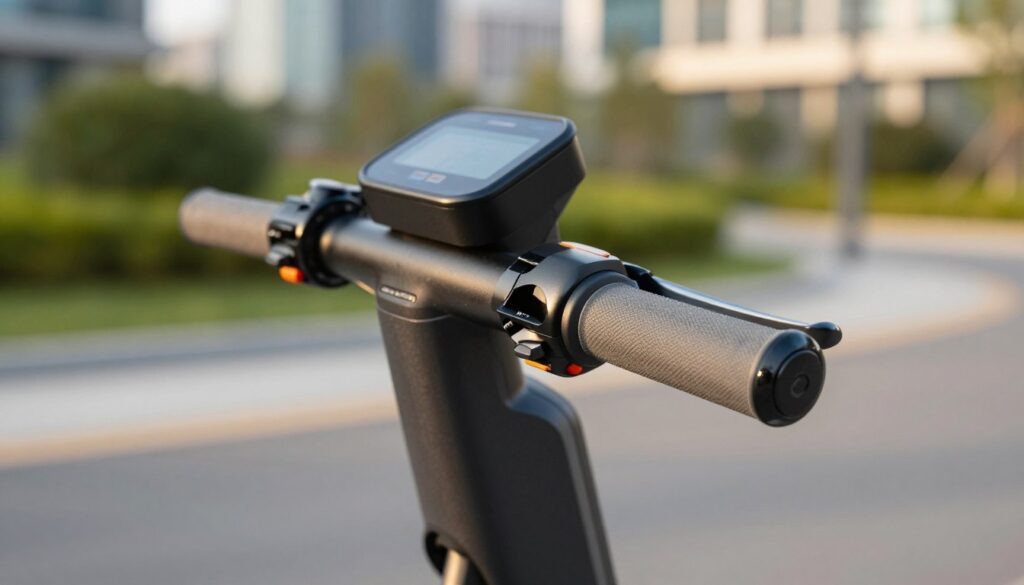
The fixed-height handlebars keep the build light but remove adjustability. Throttle sits on the right, brake lever on the left, and a simple LED replaces a full speed display for basic battery control.
The multifunction bell doubles as a latch and a hook, a small design touch that improves daily convenience in tight city places like cafés or offices.
- Key points: strong aluminum frame, quick folding in seconds, handlebars optimized for simplicity.
- Check stem tightness periodically and use the bell hook to secure the folded scooter for easy stowing.
Ride Quality and Handling on Real Roads
City pavement and curb cuts reveal a scooter’s true character on every commute. Reviewers and everyday riders often note that first impressions matter more than specs.
Balance and control for new riders
First-time riders usually feel a short wobble at low speed. With a few blocks of practice their stance and control settle quickly.
Tip: start slow, keep knees soft, and look where you want to go to build confidence fast.
8.5-inch pneumatic tires vs. no suspension
The 8.5-inch pneumatic tires absorb small bumps and give a grippier feel on wet patches. However, there is no suspension, so larger cracks and cobblestones can feel harsh.
Practical note: tire pressure and quality greatly affect comfort and pinch-flat risk on rough surfaces.
Clearance issues and scraping
Low deck clearance leads to occasional bottom scraping at curb cuts and pavement edges. Many riders avoid this by slowing and lifting slightly over abrupt transitions.
Commuters should match local road conditions to the scooter’s limits. Some keep the stock setup, while others add suspension kits or upgraded tires to improve daily performance.
- Slow early for rough patches.
- Scan farther ahead to choose smoother lines.
- Consider upgrades if routes are often uneven.
Speed, Throttle Feel, and Riding Modes
How a scooter responds to throttle inputs shapes every minute of a commute. Riders notice this in the first few seconds after they push off and when they merge with bike-lane traffic.
Push-to-start and safety
The scooter requires a short push kick before the throttle will engage. This push-to-start behavior reduces accidental acceleration and eases the initial battery load.
Why it helps: on crowded sidewalks or near doors, it prevents sudden lurches that can startle pedestrians and new riders.
Eco vs. normal: trade-offs
In Eco mode the top speed drops (around 11 mph commonly) and acceleration softens. That saves battery and extends range but adds a bit of trip time.
Normal mode gives stronger throttle response and faster pace. Riders should choose the level that matches their route, weight, and headwind conditions for best performance.
Cruise control and quick checks
Cruise usually locks after holding the throttle steady for about five seconds and cancels with brake input. It helps on long, flat stretches but is risky in dense areas.
The stem-mounted button and LED let riders confirm mode and battery level at a glance. The app can enable or tweak settings, but it is no replacement for cautious riding.
- Tip: use Eco for longer days, Normal for busier traffic.
- Tip: engage cruise only where stops are rare and visibility is good.
- Tip: check the detailed retailer page for official mode descriptions and updates.
Brakes, Braking Distance, and Safety Features
A reliable stop and bright lights give riders real confidence on busy streets.
Dual braking system and everyday feel
The scooter pairs a front E-ABS regenerative system with a rear mechanical disc. This combo balances energy recovery with strong, physical stopping power.
Riders report firm brakes that feel predictable for commuting. The front regen eases load while the rear disc finishes the stop.
Braking distance and rider tips
At about 20 km/h braking distance is often 3–4 meters in good conditions. Dusty or wet pavement can add distance and make stops less smooth.
Tip: use progressive lever input, leave extra space, and avoid sudden pulls with the small wheels. Practice short stops in a safe area to build confidence.
Lights, visibility, and the app lock
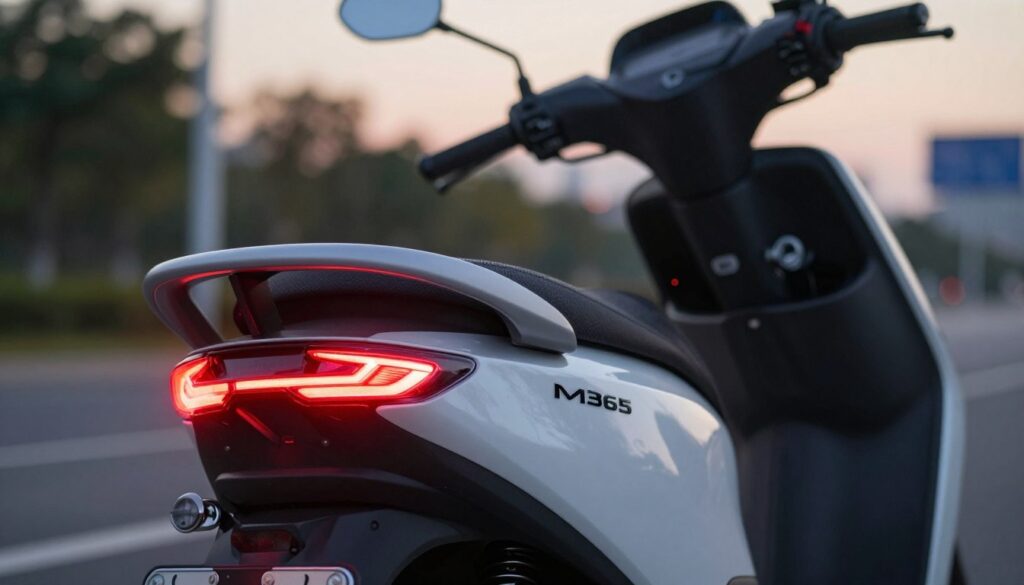
The built-in 1.1W LED headlight and a flashing rear light plus reflectors help others see the rider. Many commuters add brighter lights for true night use.
The app lock is useful as a deterrent but not real theft prevention. For better security use a vetted U-lock, secure to an immovable object, and bring the scooter indoors when possible.
- Quick safety checklist: check brakes before each ride, keep lights clean, and lock to solid fixtures.
- Prefer high-traffic parking and carry a strong physical lock.
Battery, Range, and Charging Expectations Over Time
Daily range and charging habits decide whether a scooter fits a commuter’s routine. Riders should plan trips around realistic numbers, not just the claimed figures on spec sheets.
Realistic range targets for commuters and heavier riders
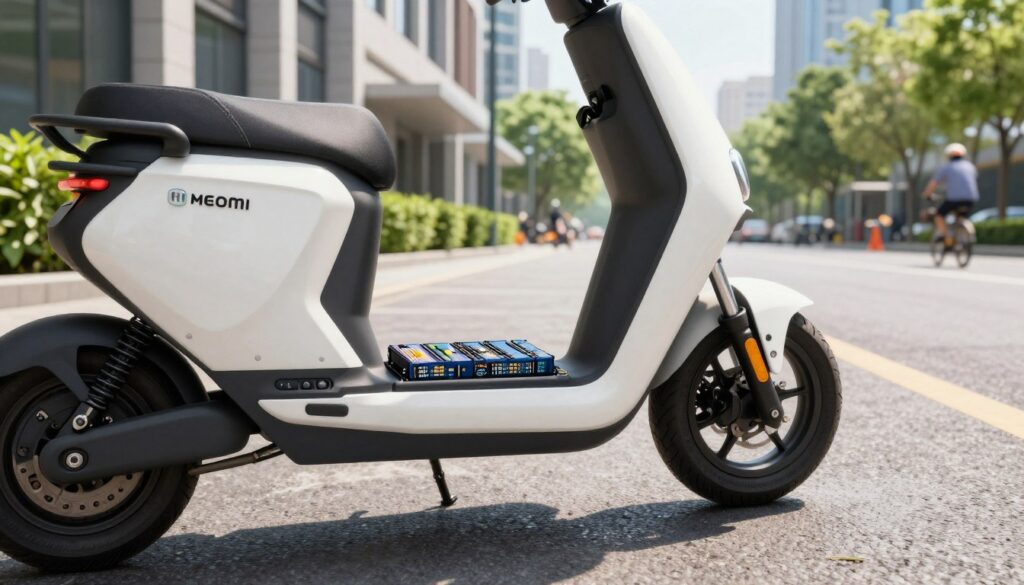
Claimed range is often ~18 miles, but many riders see closer to 15 miles in normal city use. Stop-and-go riding, headwinds, and hills cut distance more for heavier riders.
Tip: match daily mileage to a conservative range estimate and add a buffer to avoid surprises.
Performance drop when battery gets very low
Speed and acceleration feel strong early, then fall off. Reviewers note a sharp power and performance drop when the battery falls under about 5%.
Plan charging so the ride avoids that low level. That keeps commutes predictable and safer.
Regenerative braking and energy recovery settings to use safely
The regen system can recover energy and gently extend range. Higher regen changes braking feel and can stress the system at full charge.
Many riders pick a mild regen level and charge overnight (typical charge time ~5 hours). Topping up at work when possible is a smart commuting strategy.
- Use conservative range estimates for daily planning.
- Avoid deep discharge to prevent sudden performance loss.
- Set regen to a mild level and monitor app settings for safety.
Best Xiaomi M365 Accessories and Upgrades Worth Buying
A handful of well-made add-ons will cut downtime, boost safety, and make each trip more comfortable.
Visibility first: brighter headlight and rear light options
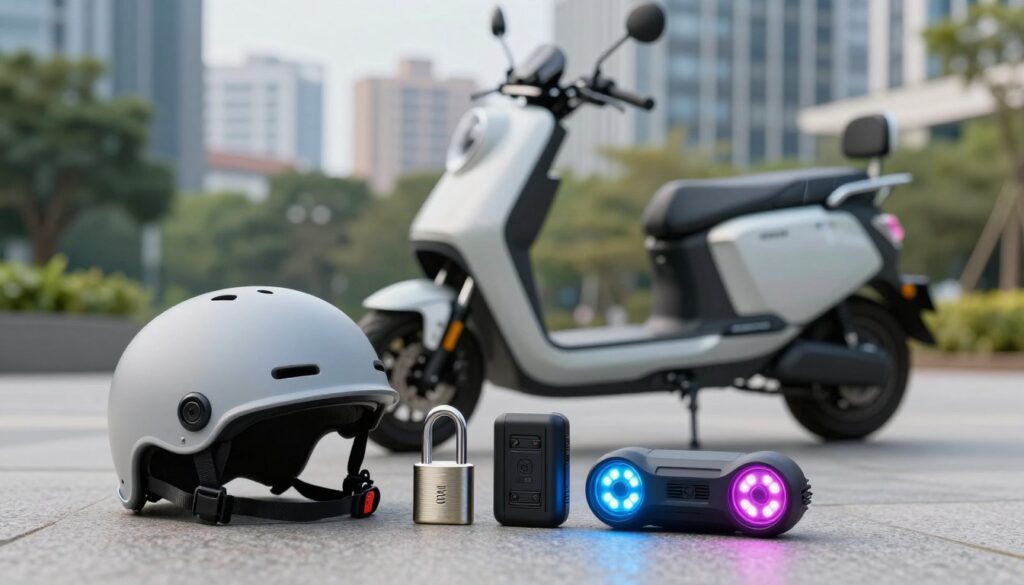
Upgrade the stock headlight with a high-lumen LED unit and add a strong rear light. Better lights increase rider visibility and reaction time on dim streets.
Flat prevention: tire care, sealant, and repair kit
Keep tires at ~45–50 PSI, use sealant to reduce pinch flats, and carry a compact repair kit. These steps cut the chance of being stranded mid-commute.
Comfort mods: suspension kits and grip upgrades
Simple front or rear suspension kits soften rough pavement. Better grips and a padded stem cap reduce hand fatigue for longer rides.
Protection and durability
Fit a stronger battery cover, improved fenders, and extra deck traction. These parts protect key components and keep shoes from slipping in rain.
Security and cockpit upgrades
Use a rated U-lock for real theft deterrence rather than relying on app locks. For performance and convenience, install an M365 Pro-style LED dashboard to monitor speed, mode, and throttle at a glance.
- Top accessories: brighter lights, sealant, U-lock, battery cover, LED dashboard.
Xiaomi M365 vs. M365 Pro and Other Electric Scooters to Consider
A commuter’s choice often comes down to clear trade-offs: extra range, a nicer dashboard, or easier rolling through stations. This short guide matches those needs to the right model and price point.
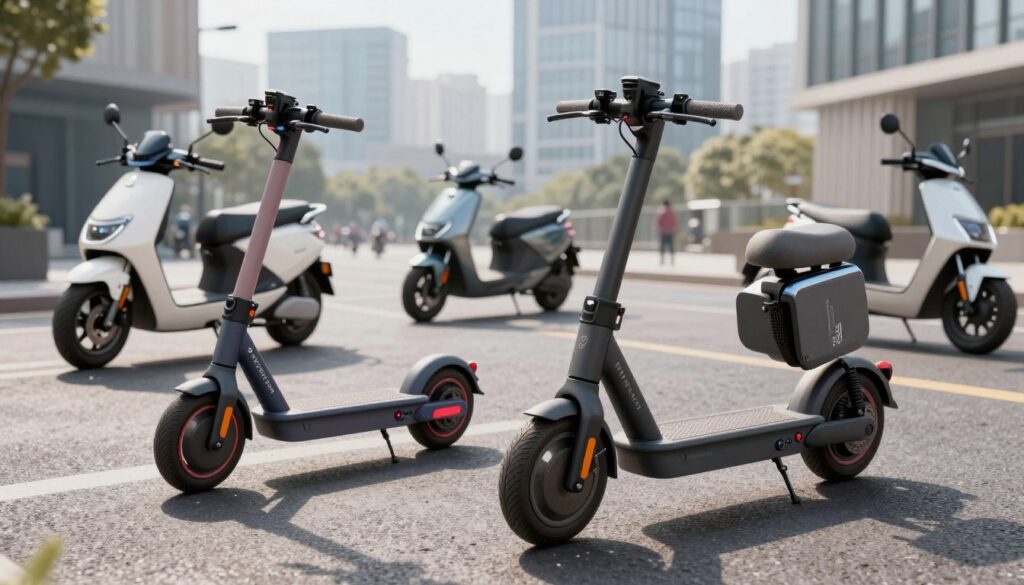
When the Pro upgrade makes sense
The m365 pro adds an upgraded LED dashboard, a higher-mounted headlight, IP54 sealing, and a magnetized charging-port cover. These small fixes cut daily annoyances and improve visibility.
Out of the box the Pro’s top speed is only modestly higher — typically around 18 mph — and firmware tweaks can push ~20 mph but carry risk. Choose the Pro for the dashboard, water resistance, and slightly higher range, not for a huge mph gain.
Portability alternative: rolling convenience
For transit riders, a Glion Dolly–style scooter trades low weight for rolling convenience. It often has suspension and never-flat tires that roll easily through stations and offices.
Why that matters: rolling beats carrying on stairs and saves energy during multi-leg commutes.
Range-focused alternative: longer-distance trade-offs
Ninebot Max–style scooters target riders who need much more range — often cited near ~40 miles. They reduce charging stress but add serious weight and price.
The trade-off is clear: more range and power for fewer charging stops, at the cost of portability and a higher purchase price.
- Choose the base xiaomi m365 if price, parts availability, and a light fold matter.
- Choose the m365 pro for the dashboard, sealed port, and small range/headlight upgrades.
- Consider Glion-style if rolling convenience is a daily priority.
- Pick a Max-style when range outweighs carrying and budget limits are looser.
Bottom line: match the scooter to your place and routine. In today’s market the xiaomi mijia m365 still wins for parts support and a wide accessories ecosystem, but the Pro and other brands solve specific commuter problems better.
Is the Xiaomi M365 Still a Smart Buy Right Now?
When weighing price, serviceability, and everyday performance, the m365 remains a sensible choice for many riders. It delivers a reliable electric scooter experience with predictable braking, simple folding, and a huge parts and accessories ecosystem that keeps repairs affordable.
Limitations matter: real-world range falls short of claims for heavier riders, there is no suspension, and tires need care to avoid flats. Visibility and defensive riding improve safety on small-wheel scooters.
Buying checklist: verify authenticity, inspect the brake system, confirm battery health if used, and budget for a strong lock plus brighter lights.
Recommendation: great for short-to-medium daily miles. For longer range or higher sustained speed, consider the best electric scooters that target distance and power instead.
FAQ
What are the top specs riders should check on the Xiaomi Mijia M365 scooter?
They should look at top speed in mph, motor power, and real-world hill performance, plus range in miles, battery capacity, charger output, and total weight. Tire type, rider weight limit, and folded dimensions also affect daily use and portability.
Who is the M365 best suited for among U.S. commuters?
It fits casual commuters who need a lightweight, foldable scooter for short trips and mixed transit days. It suits riders prioritizing convenience and a compact design over top speed or long range.
Who should skip the M365 in favor of a faster or longer-range scooter?
Riders who commute long distances, carry heavy loads, or want higher top speeds should choose models with bigger batteries and stronger motors, such as range-focused or performance scooters that offer better hill climbing and sustained speed.
What realistic range can riders expect and what affects it?
Typical urban range drops below the rated miles when carrying heavier riders, climbing hills, or riding in stop-and-go traffic. Speed, rider weight, tire pressure, and temperature all influence real-world distance.
How long does the battery take to charge and what matters about the charger?
Charge time depends on charger output and battery size; expect several hours for a full charge. Using the correct charger and avoiding frequent deep discharges helps preserve battery life over time.
How heavy is the scooter and what are the rider limits?
The scooter’s curb weight and the rider weight limit determine portability and safety. Users should check both folded and unfolded dimensions to know whether they can carry it comfortably or need a rolling option.
Are the tires and deck suitable for rough roads?
The scooter uses 8.5-inch pneumatic tires without dedicated suspension. They provide decent cushioning but won’t match suspension-equipped models on very rough pavement; watch for curb and edge clearance issues.
How does the folding mechanism perform in daily use?
The folding latch works quickly and allows compact storage in seconds. In practice, carrying versus rolling the folded scooter depends on user strength and the scooter’s weight; some prefer a dolly-style alternative for long treks.
What controls are on the handlebars and is there a bell hook?
Controls include a throttle, brake lever, power button, and mode selector. The multifunction bell hook or mount helps attach lights or aftermarket bells for improved signaling and safety.
What is the push-to-start behavior and why does it matter?
The scooter requires a brief push to engage the motor for safety and battery preservation. This prevents accidental throttle activation and helps preserve range by avoiding unnecessary motor use at rest.
How do riding modes affect speed and range?
Eco mode limits top speed and softens acceleration to extend range. Normal mode delivers stronger acceleration and higher speed at the cost of battery life. Choosing the right mode balances commute needs and battery preservation.
Does the scooter have cruise control and when is it useful?
Yes, cruise control holds a steady speed after the throttle is engaged for a short time. It’s useful on flat stretches to reduce thumb fatigue, but riders should disengage it in heavy traffic or when navigating uneven surfaces.
What braking system does it use and how effective is it?
It combines an electronic anti-lock regenerative front brake with a rear mechanical disc brake. This gives predictable stopping power for city riding; real braking distance varies with speed, weight, and road conditions.
How well do the lights work for night riding?
The headlight and rear light provide basic visibility for urban riding. Upgrading to brighter LED head and tail lights improves safety on poorly lit roads and increases visibility to other road users.
Is the app lock feature enough to prevent theft?
App lock helps deter casual use but is not a full theft-prevention solution. Use a solid U-lock or heavy-duty chain and secure the scooter to fixed objects for real protection in urban areas.
How does battery performance change over time and with heavy use?
Batteries gradually lose capacity after many charge cycles. Heavy riders, frequent fast charging, and deep discharges accelerate decline. Proper charging habits and temperature care extend usable life.
Does regenerative braking noticeably extend range?
Regenerative braking recovers a small amount of energy and can slightly extend range in city stop-and-go riding, but it’s not a substitute for battery capacity. It’s best used as a complement to good riding technique.
What accessories are most worth buying for daily riders?
Prioritize visibility upgrades (brighter headlight, rear light), flat-prevention solutions (sealant, spare tubes), comfort mods (suspension kits, better grips), and security (solid locks). Protective fenders and stronger deck covers also add durability.
When does the M365 Pro or other scooters make more sense?
Upgrade to a pro or a larger-range model if the rider needs longer range, a sealed battery pack, a clearer dashboard, or stronger hill performance. Alternatives like Glion-style rolling scooters favor portability, while Ninebot Max-style scooters prioritize range.
Is this scooter still a smart buy right now?
It remains a solid value for short commutes and first-time electric scooter riders who want a reliable, foldable option. Those needing higher speed, greater range, or rugged performance should compare newer models before deciding.
What maintenance should riders perform regularly?
Regular checks include tire pressure, brake pad wear, stem and folding latch tightness, and battery health. Cleaning contacts, tightening bolts, and addressing punctures promptly will keep the scooter safe and reliable.
How fast can riders expect the scooter to go on flats?
Expect moderate top speeds suitable for urban streets; exact mph depends on rider weight, incline, and battery charge. Riding in eco mode reduces top speed but boosts range for longer trips.
Are there common durability issues to watch for?
Common notes include stem wear from repeated folding, tire punctures, and cosmetic scratches. Upgrading certain covers and handling the scooter gently during transport reduces long-term wear.